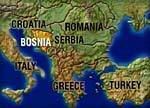
SARAJEVO, Bosnia (February 24,2008) - The U.S. Government, through the U.S. Agency for International Development (USAID) announced that U.S. Ambassador to Bosnia Charles English, the Swedish Ambassador to Bosnia Lars-Erik Wingren and the Ambassador of the Netherlands to Bosnia Karel E.T.I. Vosskuhler have launched an expansion of the jointly funded, $30-million program for the Bosnian municipalities. The program is the second phase of the US-Swedish, $20-million Governance Accountability Project (GAP).
The second phase was launched at a conference in the Bosnian capital Sarajevo that brought together the mayors of GAP’s 56 partner municipalities.
GAP assisted 41 municipalities throughout Bosnia so far to build their capacities and improve service provision to citizens.The development of One-Stop-Shops (OSSs) was a GAP flagship activity intended to provide efficient, user-friendly and transparent service delivery, increase citizens’ satisfaction and improve trust in local government and democracy.
Since December 2005, when the first GAP-supported OSS was inaugurated, an additional 40 citizen service centers have been opened, benefiting some 1.5 million Bosnian citizens.
Over the next five years, an additional 30 municipalities will participate in similar activities in the second phase of GAP. As a unique example of donor coordination, GAP will continue to establish OSSs, improve budgeting and financial management, and advance urban planning and zoning, USAID said.
.
Showing posts with label Lars-Erik Wingren. Show all posts
Showing posts with label Lars-Erik Wingren. Show all posts
Sunday, February 24, 2008


Wednesday, February 20, 2008
THREE STUDIES ON BOSNIAN STATE ADMINISTRATION PRESENTED
SARAJEVO, Bosnia (February 20,2008) – Three studies dedicated to the issue of functioning of management of the Bosnian state administration were presented yesterday in the Bosnian capital Sarajevo. Those are the UNDP report entitled “Voice of the Silent Majority”, the Bosnian Foreign Policy Initiative’s “Management Structures in Bosnia” and University of Aberdeen’s Professor Dr. Michael Keating’s “Study on Federalism in Bosnia”.
As stated by one of the introducers, the Swedish Ambassador to Bosnia Lars-Erik Wingren, whose country financially supported the research, those works are aimed to offer an insight into the understanding of this issue in Biosnia.
According to him, the reports offer strong reasons for changes and they contain important reforms which are necessary for association to the EU.
Ambassador Wingren emphasized that it will be a long and painstaking process in all sectors of the Bosnian society, but that the Bosnian citizens will benefit in the end.
Ambassador of Holland to Bosnia Karel Vosskuhler, whose country also helped this research stated that the central element is the process which will bring all Bosnian state institutions closer to the EU standards, which is the biggest test for Bosnia's politicians.
Emphasizing that all has gone wrong in Bosnia after the refusal to adopt the April Package of constitutional changes, he emphasized that the politicians need to get out of their armour and make all the changes necessary to the Bosnian Constitution and achieve a consensus which is now gone.
Head of the Operations at the European Commission’s Delegation to Bosnia Ferdinand Kopp emphasized that the EU leaders recently re-emphasized their approach that the Union is open for all the countries of the Southeastern Europe.
”EU will work on your perspective but you need to fulfil all the conditions necessary for the integrations”, he said.
Kopp believes that the European perspective is the only vision there is for the countries of the Southeastern European region and, keeping in mind that there is a specific problem in Bosnia, EU membership would be the best way to overcome the wounds from the past.
”That is why there is no alternative to the reforms. Administrative reform is one of the most important reforms”, he said.
Kopp emphasized the fact that the public debate that has been going on has been giving signals that radical decisions need to be made in Bosnia in order to progress in the EU integration processes.
.
Subscribe to:
Posts (Atom)